
By Charry Jane S. Gariando, JD1
INTRODUCTION
The Philippine Business Process Outsourcing (BPO) industry stands as one of the country’s most economically significant sectors, employing millions of workers and contributing substantially to national economic growth. For decades, the industry’s competitive advantage has relied heavily upon Filipino workers’ communication skills, adaptability, customer engagement, and cultural compatibility with global markets.
However, the rapid advancement of Artificial Intelligence (AI), machine learning systems, predictive analytics, automated customer support platforms, and virtual assistants has fundamentally transformed operational models across the industry. Companies increasingly adopt AI technologies to reduce labor costs, optimize workflow efficiency, minimize human error, and improve service availability.
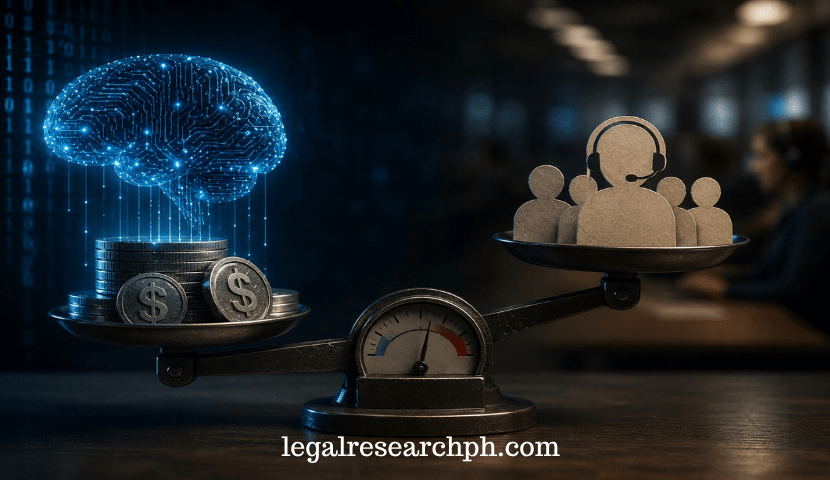
While technological innovation may improve business efficiency, it simultaneously raises a profound legal and constitutional question: May economic efficiency and automation lawfully outweigh the constitutional guarantee of security of tenure and the State’s duty to protect labor?
This legal issue extends beyond mere operational modernization. The integration of AI into workplace systems directly affects employment stability, worker dignity, due process rights, accountability structures, and the broader constitutional framework governing labor relations in the Philippines.
Under Philippine law, employers retain management prerogative, including the authority to reorganize operations, introduce labor-saving devices, and adopt cost-efficient technologies. Nevertheless, such authority is not absolute. The Constitution expressly mandates the State to afford full protection to labor, promote social justice, and guarantee workers’ rights to security of tenure and humane working conditions.
As AI systems increasingly perform cognitive, communicative, and decision-making functions previously handled by human employees, traditional labor doctrines face unprecedented challenges. Existing labor regulations were primarily designed for conventional mechanization and industrial automation rather than advanced AI systems capable of replacing complex human interactions and workplace functions.
This study argues that although AI adoption may constitute a legitimate exercise of management prerogative under certain circumstances, its implementation must remain subject to constitutional safeguards, good faith requirements, procedural due process, and ethical limitations designed to preserve human dignity and social justice.
Furthermore, this research emphasizes that despite technological advancement, the “human touch” remains legally and ethically significant. Human oversight, empathy, contextual reasoning, moral accountability, and discretionary judgment continue to play indispensable roles in customer service, labor governance, dispute resolution, and data protection.
Ultimately, this paper seeks to contribute to emerging legal discourse on AI governance and labor protection by examining whether Philippine labor law remains sufficient to address AI-driven displacement in the modern workplace.
HISTORICAL AND LEGISLATIVE CONTEXT
The Philippine BPO industry emerged during the late 1990s and early 2000s as a major driver of economic development, foreign investment, and employment generation. Initially centered on customer service and technical support operations, the industry expanded rapidly due to the availability of English-speaking Filipino workers and comparatively lower labor costs.
Over time, the industry evolved into one of the largest employment sectors in the country, supporting millions of workers across customer service, technical support, healthcare information management, finance, and back-office operations.
Historically, labor-saving technologies primarily involved mechanized tools and software systems that supplemented human labor rather than replacing cognitive workplace functions. Philippine labor laws governing authorized causes of termination, redundancy, and labor-saving devices were therefore drafted within the context of traditional industrial modernization.
The emergence of advanced AI systems, however, significantly alters the legal landscape. Modern AI platforms are capable of performing tasks involving language processing, behavioral prediction, automated communication, sentiment analysis, customer interaction, and operational decision-making. Unlike conventional tools, AI systems increasingly replicate functions previously dependent upon human cognition and interpersonal interaction.
This technological transformation generates substantial legal concerns involving:
• Security of tenure
• Authorized termination
• Good faith implementation
• Due process protections
• Accountability for automated decisions
• Transparency in algorithmic systems
• Data privacy and employee monitoring
• Ethical governance of workplace automation
The absence of AI-specific labor legislation in the Philippines creates regulatory uncertainty regarding the legal limits of automation-driven workforce reduction. Consequently, existing constitutional principles, labor doctrines, jurisprudence, and data privacy regulations become critically important in determining whether AI-driven displacement remains legally permissible.
Additionally, global developments such as the European Union AI Act demonstrate growing international recognition that AI systems require specialized regulatory safeguards to prevent abuse, discrimination, opacity, and unjust labor practices.
As technological transformation accelerates, Philippine labor law faces increasing pressure to reconcile economic competitiveness with constitutional commitments to labor protection and social justice.
STATEMENT OF THE PROBLEM
This research seeks to address the following legal and policy questions:
1. Whether Artificial Intelligence may lawfully qualify as a labor-saving device under Article 298 of the Labor Code of the Philippines;
2. Whether AI-driven workforce displacement constitutes a valid exercise of management prerogative;
3. Whether existing Philippine labor laws sufficiently protect workers against arbitrary or abusive AI-related termination practices;
4. Whether AI systems may lawfully replace human participation in employment-related decision-making processes;
5. Whether constitutional guarantees of security of tenure and social justice impose limitations on AI-driven organizational restructuring;
6. Whether the Philippines should adopt AI-specific labor regulations similar to international regulatory frameworks.
OBJECTIVES OF THE STUDY
This research aims to:
1. Examine the legality of AI-driven workforce displacement under Philippine labor law;
2. Analyze Article 298 of the Labor Code concerning redundancy and labor-saving devices;
3. Define the legal limits of management prerogative in the adoption of AI systems;
4. Evaluate the constitutional implications of AI-driven employment restructuring;
5. Assess the necessity of human oversight in AI-assisted workplace systems;
6. Compare foreign regulatory frameworks governing AI and employment;
7. Propose legislative and policy reforms addressing AI governance and labor protection in the Philippines.
METHODOLOGY
1. Research Design
This study employs doctrinal legal research using descriptive, analytical, and comparative approaches. The research analyzes constitutional provisions, labor statutes, jurisprudence, legal commentaries, policy studies, and international regulatory frameworks concerning Artificial Intelligence and labor governance.
The doctrinal approach focuses on interpreting and synthesizing existing legal principles governing management prerogative, labor-saving devices, redundancy, due process, and constitutional labor protection.
The comparative approach examines foreign regulatory models, particularly the European Union AI Act, to evaluate potential frameworks applicable to Philippine labor regulation.
2. Legal Framework
This study is primarily anchored upon the following legal authorities:
• Article XIII, Section 3 of the 1987 Philippine Constitution;
• Article 298 of the Labor Code of the Philippines;
• Jurisprudence concerning management prerogative and authorized causes of termination;
• Republic Act No. 10173 or the Data Privacy Act of 2012;
• Principles of substantive due process and social justice.
3. Sources of Data
Primary Sources
• The 1987 Constitution of the Republic of the Philippines;
• The Labor Code of the Philippines;
• Republic Acts and administrative regulations;
• Supreme Court jurisprudence;
• International regulatory instruments.
Secondary Sources
• Legal commentaries;
• Academic journals;
• Labor law studies;
• AI governance research;
• Policy papers;
• Comparative legal analyses.
4. Method of Legal Analysis
The study applies statutory interpretation, jurisprudential synthesis, constitutional balancing, and policy analysis in evaluating the legality of AI-driven labor displacement.
Particular emphasis is placed upon:
• Good faith requirements;
• Security of tenure protections;
• Reasonable standards for redundancy;
• Due process obligations;
• Ethical accountability in automated systems.
5. Ethical Considerations
This research recognizes the ethical implications of workplace automation, emphasizing fairness, accountability, transparency, non-discrimination, and the preservation of human dignity.
6. Scope and Limitations
The study focuses primarily on the Philippine BPO industry and the legal implications of AI integration within employment systems. The paper does not address technical engineering aspects of AI development.
Comparative international analysis is included solely to evaluate possible regulatory models relevant to Philippine labor governance.
SIGNIFICANCE OF THE STUDY
This study contributes to legal scholarship concerning the intersection of labor law, constitutional law, technology regulation, and Artificial Intelligence governance.
The research is significant to:
Workers and Employees: The study examines the extent to which existing labor laws protect workers against AI-driven displacement and arbitrary termination.
Employers and Industry Stakeholders: The paper clarifies the legal boundaries of management prerogative and organizational restructuring involving AI systems.
Policymakers and Legislators: The research provides policy recommendations for future AI-related labor legislation and regulatory reform.
Academic Institutions and Researchers: The study contributes to emerging legal discourse concerning AI governance, employment regulation, and constitutional labor protections.
Society and the Public: The paper addresses broader concerns regarding technological advancement, ethical governance, economic development, and the preservation of human dignity in modern workplaces.
DISCUSSION AND LEGAL ANALYSIS
I. ARTIFICIAL INTELLIGENCE AND THE TRANSFORMATION OF THE BPO INDUSTRY
A. Workforce Displacement and Automation
Artificial Intelligence systems increasingly perform functions traditionally assigned to human employees, including customer support, technical troubleshooting, language processing, automated communication, and data analysis.
Modern AI platforms are capable of handling high-volume customer interactions with minimal human intervention. As a result, employers increasingly adopt automation technologies to reduce operational costs, improve efficiency, and maintain competitive advantage within the global outsourcing market.
However, while automation may improve productivity, it also generates significant labor concerns involving redundancy, displacement, underemployment, and job insecurity.
Unlike conventional mechanization, AI systems increasingly replicate cognitive and interpersonal workplace functions. Consequently, workforce displacement caused by AI raises more complex legal and ethical issues than traditional labor-saving devices contemplated under earlier labor regulations.
B. Economic Motivations Behind AI Adoption
Employers commonly justify AI integration on the basis of:
• Cost reduction;
• Operational efficiency;
• Increased productivity;
• Error minimization;
• Continuous service availability;
• Global market competitiveness.
From a business perspective, AI adoption may constitute a legitimate exercise of management prerogative.
Nevertheless, constitutional labor protections impose legal limitations upon purely profit-driven restructuring measures. The constitutional principle of social justice requires balancing economic development with the protection of workers’ rights and human dignity.
The State cannot permit technological efficiency alone to become sufficient justification for arbitrary displacement of labor.
C. Decline of Human Interaction and Ethical Concerns
Despite technological advancement, AI systems remain incapable of fully replicating empathy, contextual understanding, moral reasoning, discretion, and emotional intelligence.
In customer service environments, human interaction often involves:
• Emotional sensitivity;
• Ethical judgment;
• Crisis management;
• Cultural understanding;
• Contextual interpretation.
These functions extend beyond mechanical information processing.
Additionally, automated systems raise accountability concerns involving:
• Algorithmic bias;
• Erroneous decision-making;
• Lack of transparency;
• Data misuse;
• Absence of human review.
Consequently, the preservation of meaningful human oversight remains legally and ethically necessary.
II. ARTICLE 298 OF THE LABOR CODE AND AI AS A LABOR-SAVING DEVICE
Article 298 of the Labor Code authorizes termination of employment due to installation of labor-saving devices, redundancy, retrenchment, and closure of business operations, provided that the employer complies with legal requirements including good faith implementation and payment of separation benefits.
The central legal question is whether Artificial Intelligence systems may lawfully qualify as labor-saving devices under Article 298.
The Labor Code does not expressly define Artificial Intelligence. Nevertheless, AI systems arguably fall within the broader category of labor-saving technologies designed to improve operational efficiency and reduce reliance upon human labor.
However, the mere existence of labor-saving technology does not automatically justify termination.
Philippine jurisprudence consistently requires that authorized causes of termination satisfy standards of:
• Good faith;
• Legitimate business necessity;
• Fair and reasonable implementation;
• Compliance with due process;
• Absence of arbitrariness.
In labor cases involving redundancy and restructuring, the Supreme Court has repeatedly emphasized that management prerogative cannot be exercised in a manner that circumvents constitutional labor protections.
In San Miguel Brewery Sales Force Union v. Ople, the Court recognized management prerogative while affirming that such authority remains subject to limitations imposed by law, fairness, and public policy.
Similarly, in Wiltshire File Co., Inc. v. NLRC, the Court stressed that redundancy programs must be implemented in good faith and supported by fair and reasonable criteria.
Consequently, AI-driven termination programs must demonstrate genuine operational necessity rather than mere preference for cheaper labor alternatives.
Employers adopting AI systems must therefore establish:
• Actual business necessity;
• Reasonable standards for employee selection;
• Fair implementation procedures;
• Compliance with labor standards;
• Good faith restructuring;
• Proper notice and separation benefits.
Absent these safeguards, AI-driven workforce reduction may constitute illegal dismissal.
III. MANAGEMENT PREROGATIVE VERSUS SECURITY OF TENURE
Management prerogative refers to the employer’s inherent right to regulate all aspects of employment, including hiring, supervision, transfer, restructuring, and operational modernization.
Philippine jurisprudence recognizes that employers possess discretion in managing business operations to ensure efficiency and profitability.
However, management prerogative is not absolute. Under Article XIII, Section 3 of the 1987 Constitution, the State is mandated to afford full protection to labor and guarantee workers’ rights to security of tenure. Thus, employer discretion must remain subordinate to constitutional limitations, due process requirements, and principles of fairness.
In Philippine Long Distance Telephone Company v. NLRC, the Supreme Court reiterated that while employers retain business discretion, workers remain entitled to constitutional protection against arbitrary termination.
Similarly, in Fuji Television Network v. Espiritu, the Court emphasized that management prerogative cannot override labor rights protected by law and public policy. The integration of AI into workplace systems intensifies this constitutional balancing problem. On one hand, employers argue that:
• AI improves competitiveness;
• Operational modernization is necessary for economic survival;
• Global outsourcing markets require technological adaptation.
On the other hand, workers face:
• Employment instability;
• Economic displacement;
• Reduced bargaining power;
• Uncertainty regarding future employability.
The constitutional principle of social justice requires balancing these competing interests. Technological advancement cannot become a mechanism for weakening labor protection or disguising unlawful dismissal. Consequently, courts must carefully evaluate whether AI-driven restructuring genuinely serves legitimate business purposes or merely prioritizes cost reduction at the expense of constitutional rights.
IV. GOOD FAITH REQUIREMENT IN AI-DRIVEN TERMINATION
Good faith remains one of the most important legal standards governing authorized causes of termination. Under Philippine labor jurisprudence, employers must prove that redundancy or labor-saving measures are implemented honestly, reasonably, and without intent to circumvent labor protections.
Good faith requires:
• Legitimate business necessity;
• Fair selection criteria;
• Transparency in implementation;
• Non-discriminatory application;
• Compliance with procedural due process.
In redundancy cases, courts commonly examine whether:
• Positions are genuinely unnecessary;
• Restructuring is economically justified;
• Standards for termination are fair and reasonable;
• Employer actions are motivated by legitimate operational concerns.
AI-related restructuring creates additional complexities because automated systems may obscure decision-making processes. Employers may increasingly rely upon algorithmic systems for:
• Productivity evaluation;
• Employee monitoring;
• Workforce analytics;
• Behavioral prediction;
• Performance assessment.
However, opaque algorithmic systems may undermine transparency and accountability. Without meaningful human oversight, employees may face termination decisions based upon:
• Inaccurate data;
• Biased algorithms;
• Automated scoring systems;
• Undisclosed evaluation criteria.
Such practices potentially violate constitutional due process principles and labor standards requiring fairness and good faith.
Therefore, AI-assisted employment decisions must remain subject to human review and legal accountability.
V. DATA PRIVACY, ACCOUNTABILITY, AND HUMAN OVERSIGHT
The increasing use of AI systems within workplaces also raises substantial concerns under Republic Act No. 10173 or the Data Privacy Act of 2012.
AI systems frequently process large volumes of employee and customer data involving:
• Behavioral analytics;
• Productivity metrics;
• Communication monitoring;
• Performance evaluations;
• Biometric information.
The automated processing of personal data creates risks involving:
• Unlawful surveillance;
• Unauthorized data collection;
• Algorithmic discrimination;
• Privacy violations;
• Lack of transparency.
Under the Data Privacy Act, personal data processing must comply with principles of:
• Transparency;
• Legitimate purpose;
• Proportionality.
Employers adopting AI systems therefore remain legally obligated to ensure that automated workplace technologies comply with privacy regulations and data protection standards. Moreover, accountability concerns become particularly significant when AI systems influence employment decisions. Unlike human supervisors, AI systems cannot independently assume legal or moral responsibility for harmful outcomes. Consequently, meaningful human oversight remains necessary to:
• Review automated decisions;
• Correct algorithmic errors;
• Ensure fairness;
• Maintain legal accountability.
The preservation of human participation in employment-related decision-making therefore serves not merely ethical purposes but also legal and constitutional functions.
VI. COMPARATIVE LEGAL FRAMEWORKS
A. The European Union AI Act
The European Union AI Act represents one of the most comprehensive regulatory frameworks governing Artificial Intelligence.
The Act classifies AI systems according to risk categories and imposes varying levels of regulatory obligations depending upon the potential impact of the technology.
High-risk AI systems involving employment, worker management, and access to essential services are subject to heightened transparency, accountability, and human oversight requirements.
The EU framework recognizes that automated systems may significantly affect:
• Employment rights;
• Access to livelihood;
• Privacy interests;
• Human dignity.
Consequently, the regulation requires safeguards including:
• Human supervision;
• Transparency obligations;
• Risk assessments;
• Documentation requirements;
• Accountability mechanisms.
B. Human-in-the-Loop Principle
A central principle within modern AI governance is the “human-in-the-loop” framework.
This principle ensures that meaningful human participation remains present in AI-assisted systems, particularly where decisions significantly affect individual rights and interests.
Within labor relations, the human-in-the-loop principle becomes especially important in:
• Hiring decisions;
• Disciplinary actions;
• Redundancy programs;
• Employee evaluation;
• Termination proceedings.
The principle prevents full delegation of legally significant decisions to automated systems.
C. Possible Philippine Application
Although the Philippines currently lacks comprehensive AI legislation, several aspects of the EU approach may provide useful guidance for future labor regulation.
Potential reforms may include:
• Mandatory AI impact assessments;
• Algorithmic transparency requirements;
• Human oversight obligations;
• Workplace automation reporting systems;
• Anti-discrimination safeguards;
• AI accountability standards.
The adoption of AI-specific labor safeguards would strengthen constitutional labor protection while permitting responsible technological innovation.
VII. CONSTITUTIONAL ANALYSIS: SOCIAL JUSTICE AND HUMAN DIGNITY
The constitutional principle of social justice occupies a central role within Philippine labor law.
Article XIII, Section 3 of the Constitution expressly directs the State to afford full protection to labor and guarantee workers’ rights to security of tenure, humane working conditions, and participation in policy-making processes affecting their welfare.
The Constitution recognizes that labor is not merely a commodity subject to unrestricted market forces.
Consequently, technological advancement cannot be evaluated solely through the lens of economic efficiency.
AI-driven restructuring must also be examined in relation to:
• Substantive due process;
• Fairness;
• Equality;
• Dignity;
• Constitutional labor protection.
Human dignity remains particularly important within AI governance.
Workers are not simply operational costs to be minimized through automation.
Employment provides:
• Economic survival;
• Social participation;
• Personal identity;
• Stability;
• Human development.
The unrestricted replacement of human labor by AI systems therefore carries significant constitutional and ethical implications. While the Constitution does not prohibit technological innovation, it requires that modernization remain consistent with social justice and protection of human welfare. Thus, the legal challenge lies not in preventing AI adoption altogether, but in ensuring that technological progress remains accountable to constitutional principles.
RECOMMENDATIONS
Based upon the foregoing legal analysis, the following recommendations are proposed:
1. STRENGTHEN AI-SPECIFIC LABOR PROTECTIONS
The Department of Labor and Employment (DOLE) should establish regulations clarifying:
• The legal classification of AI systems as labor-saving devices;
• Standards for lawful AI-driven restructuring;
• Safeguards against abusive automation practices.
Employers adopting AI technologies should be required to demonstrate:
• Genuine business necessity;
• Good faith implementation;
• Proportional workforce reduction;
• Compliance with due process.
2. MANDATE WORKFORCE TRANSITION PROGRAMS
Companies implementing large-scale AI systems should provide:
• Retraining programs;
• Digital literacy education;
• Career transition support;
• Alternative employment pathways.
Government agencies should likewise establish workforce adaptation initiatives addressing technological displacement.
3. REQUIRE HUMAN OVERSIGHT IN EMPLOYMENT DECISIONS
AI systems should never independently determine:
• Termination;
• Disciplinary sanctions;
• Redundancy selection;
• Employee evaluation.
All employment-related decisions involving AI systems must remain subject to meaningful human review.
4. STRENGTHEN DATA PRIVACY AND ALGORITHMIC TRANSPARENCY
The National Privacy Commission should establish AI-specific workplace data regulations requiring:
• Disclosure of automated systems;
• Transparency in employee monitoring;
• Safeguards against algorithmic bias;
• Accountability for automated decisions.
Employees should possess the right to challenge AI-assisted decisions affecting employment status.
5. AMEND THE LABOR CODE TO ADDRESS AI GOVERNANCE
The Labor Code should be amended to:
• Define Artificial Intelligence within employment contexts;
• Regulate AI-assisted labor practices;
• Establish safeguards for algorithmic decision-making;
• Clarify legal standards governing AI-driven displacement.
• Legislation should ensure that AI systems cannot be used to circumvent constitutional protections against illegal dismissal.
6. ESTABLISH A NATIONAL AI AND LABOR POLICY FRAMEWORK
The Philippine government should create a comprehensive AI governance framework involving:
• Government agencies;
• Labor organizations;
• Academic institutions;
• Industry stakeholders;
• Civil society groups.
Such framework should promote:
• Ethical AI development;
• Responsible innovation;
• Labor protection;
• Transparency;
• Accountability;
• Human dignity.
CONCLUSION
Artificial Intelligence presents both extraordinary opportunities and serious legal challenges within the Philippine BPO industry. While AI systems may improve efficiency, reduce operational costs, and enhance productivity, they also generate substantial concerns involving employment displacement, accountability, due process, data privacy, and human dignity.
Under Philippine labor law, AI systems may arguably qualify as labor-saving devices under Article 298 of the Labor Code. Nevertheless, the legality of AI-driven workforce reduction ultimately depends upon compliance with constitutional protections, good faith requirements, due process standards, and principles of social justice.
Management prerogative cannot operate without legal limitation. Employers possess the right to innovate and modernize business operations, but such authority remains subordinate to the Constitution’s mandate to protect labor and preserve human dignity. The integration of AI into workplace systems therefore requires careful constitutional balancing between economic efficiency and labor protection.
Furthermore, this research emphasizes that human participation remains indispensable within employment systems. Artificial Intelligence may process information, predict patterns, and automate communication, but it cannot fully replicate empathy, ethical judgment, accountability, contextual reasoning, and moral responsibility.
Consequently, meaningful human oversight must remain central to AI governance. Ultimately, technological advancement should enhance human capability rather than diminish human dignity.
The future of labor regulation in the age of Artificial Intelligence depends not merely upon innovation, but upon society’s willingness to ensure that progress remains guided by fairness, accountability, constitutional values, and social justice.
BIBLIOGRAPHY
Statutes and Constitutional Provisions
1987 Constitution of the Republic of the Philippines. : http://www.officialgazette.gov.ph/constitutions/1987-constitution/
Labor Code of the Philippines. : https://blr.dole.gov.ph/2014/12/11/labor-code-of-the-philippines/
Republic Act No. 10173, Data Privacy Act of 2012. : https://privacy.gov.ph/data-privacy-act/
Jurisprudence
Abbott Laboratories, Philippines v. Alcaraz, G.R. No. 192571, July 23, 2013.
Fuji Television Network, Inc. v. Espiritu, G.R. No. 204944, December 3, 2014.
Philippine Long Distance Telephone Company v. NLRC, G.R. No. 80609, August 23, 1988.
San Miguel Brewery Sales Force Union v. Ople, G.R. No. L-53515, February 8, 1989.
Wiltshire File Co., Inc. v. NLRC, G.R. No. 82249, February 7, 1991.
International Instruments
European Union Artificial Intelligence Act. : https://artificialintelligenceact.eu/
Books and Legal Commentaries
Azucena, Cesario A. The Labor Code with Comments and Cases.
Cruz, Isagani A. Constitutional Law.
De Leon, Hector S. The Labor Code of the Philippines Annotated.
Paras, Edgardo L. Civil Code of the Philippines Annotated.
Vitug, Arturo M. and Acosta, Ernesto F. Labor Law and Social Legislation.
Academic and Policy Sources
Academic journals concerning Artificial Intelligence governance, labor regulation, and technology law.
Research publications on workplace automation and employment displacement.
Policy papers concerning ethical AI governance and algorithmic accountability.
Official Websites
Department of Labor and Employment (DOLE) : https://dole.gov.ph/
National Privacy Commission (NPC) : https://privacy.gov.ph/
Official Gazette of the Republic of the Philippines : https://www.officialgazette.gov.ph/
LEGAL BASIS
1. 1987 Constitution, Article XIII, Section 3
The Constitution guarantees full protection to labor, security of tenure, humane working conditions, and social justice.
This constitutional provision serves as the primary legal framework governing the legality of AI-driven workforce displacement.
2. Labor Code of the Philippines, Article 298
Article 298 authorizes termination due to redundancy and labor-saving devices, provided that employers comply with good faith requirements, procedural due process, and separation pay obligations.
3. Republic Act No. 10173 or the Data Privacy Act of 2012
The Data Privacy Act regulates lawful processing of personal data and reinforces principles of accountability, transparency, and proportionality within automated workplace systems.
ACKNOWLEDGMENTS
The researcher expresses sincere gratitude to her professors, mentors, classmates, and academic institution for their guidance, encouragement, and support throughout the completion of this study.
Appreciation is likewise extended to professionals within the Philippine BPO industry whose experiences provided meaningful insight into the realities of technological transformation, workforce restructuring, and the evolving nature of employment in modern workplaces.
The researcher also extends heartfelt gratitude to family, friends, and loved ones whose unwavering encouragement and support served as a constant source of strength throughout this academic journey.
This study is partly grounded in firsthand experience within the Philippine BPO industry and reflects a continuing belief that technological advancement should remain aligned with fairness, accountability, labor protection, and human dignity.
ABOUT THE RESEARCHER
Charry Jane S. Gariando is a Juris Doctor student at the University of St. La Salle. She began working in the Philippine BPO industry in 2006 and served as a Technical Support Representative, Customer Service Representative, and Call Center Trainer. Her years in the industry provided firsthand insight into the realities of customer service work, workforce restructuring, and the changing relationship between technology and employment. Rooted in both legal study and lived experience, this research reflects her belief that innovation should advance efficiency without compromising fairness, accountability, and human dignity. Her work as a researcher is grounded in a continued commitment to her family, her professional development, and the broader community. It reflects an effort to contribute meaningfully to discussions on labor protection, technological governance, and social justice, while remaining attentive to the practical realities faced by workers in evolving industries.


