
By Sophie F. Rodrigazo | JD-1 (2025) Image Source I. Introduction The Public Attorney’s Office (PAO) exists nationwide as the principal government office for providing free legal assistance to indigent and other qualified persons.1 However, nationwide institutional presence does not necessarily establish equitable regional access. The central problem is whether PAO offices, public attorneys, and … Continue reading Regional Distribution of Public Attorney’s Office (PAO) Resources in the Philippines: Assessing Equitable Access To Free Legal Assistance

The Role of Social Media in Philippine Governance
by Ma. Riyan Kyle Golez JD1 and Shyrine Ortiz, JD1 INTRODUCTION Background of the Study The rise of social media has fundamentally transformed the way governments, public officials, and citizens communicate. As noted by Bashir et al. (2025), drawing on Anderson and Kumar (2019), the rapid expansion of social media has shifted communication away from … Continue reading The Role of Social Media in Philippine Governance

The Gap Between the Rights and Protections Stipulated by the Indigenous Peoples’ Rights Act of 1997 and Their Actual Implementation in Ancestral Domains
by Maorin Aguilar, JD1 & Athaliah Juanillo, JD1 INTRODUCTION Indigenous peoples in the Philippines have long endured historical injustices rooted in dispossession of ancestral lands, marginalization from mainstream political and economic structures, and the gradual erosion of their cultural integrity (Republic Act No. 8371, 1997; National Commission on Indigenous Peoples [NCIP], 1998). In response to … Continue reading The Gap Between the Rights and Protections Stipulated by the Indigenous Peoples’ Rights Act of 1997 and Their Actual Implementation in Ancestral Domains

Defining the Limits of Warrantless Digital Searches under the 1987 Philippine Constitution
By Jalin Reign P. Lim, JD ! “Certain constitutional guarantees work together to create zones of privacy wherein governmental powers may not intrude, and that there exists an independent constitutional right of privacy. Such right to be left alone has been regarded as the beginning of all freedoms." – Disini v. Secretary of Justice, G.R. … Continue reading Defining the Limits of Warrantless Digital Searches under the 1987 Philippine Constitution

Understanding Cyberbullying: Bridging Law and Digital Free Speech in the Philippines
By Nessy Jovanah G. Bagnol, JD 1 and Gianne Frances M. Jesena, JD 1 INTRODUCTION The rapid expansion of digital communication has reconfigured the meaning, reach, and consequences of speech. In the Philippines, where online platforms function as primary arenas for social interaction and political discourse, expression is no longer confined by time, geography, or … Continue reading Understanding Cyberbullying: Bridging Law and Digital Free Speech in the Philippines
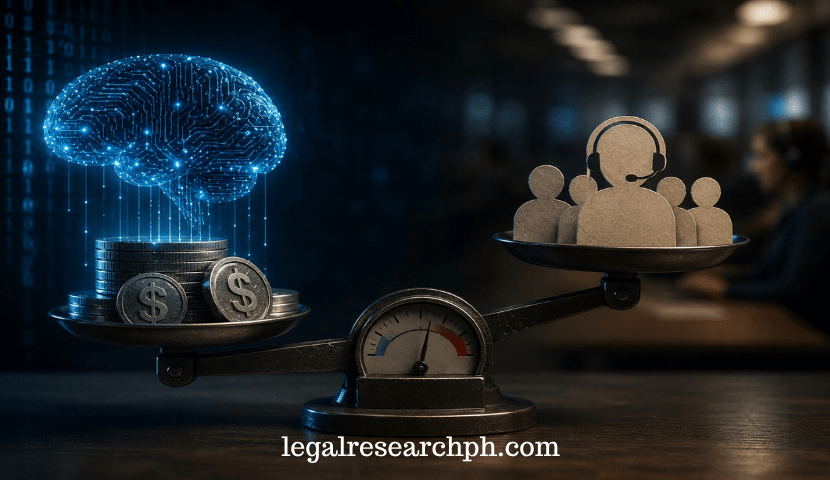
Saving Money or Losing Jobs? “The Impact of Artificial Intelligence on Call Centers, Employment, and the Human Touch”
By Charry Jane S. Gariando, JD1 INTRODUCTIONThe Philippine Business Process Outsourcing (BPO) industry stands as one of the country’s most economically significant sectors, employing millions of workers and contributing substantially to national economic growth. For decades, the industry’s competitive advantage has relied heavily upon Filipino workers’ communication skills, adaptability, customer engagement, and cultural compatibility with … Continue reading Saving Money or Losing Jobs? “The Impact of Artificial Intelligence on Call Centers, Employment, and the Human Touch”

Infant Misidentification as actionable medical negligence under Philippine civil law
By: Nicole Billanes and Glynis Amor Caduhada Introduction Childbirth is universally expected to be a milestone of profound joy and absolute safety, yet systemic failures within healthcare facilities may lead to the error of neonatal misidentification. Although statistically rare, its catastrophic anomaly was brought to the forefront of Philippine public consciousness in a widely publicized … Continue reading Infant Misidentification as actionable medical negligence under Philippine civil law

Algorithmic Accountability: Reconciling the Use of AI in Legal Pleadings with the Lawyer’s Duty of Candor under the Code of Professional Responsibility and Accountability (CPRA)
By Ijssel Dumancas and Japhet Patriz Antonio, JD1 INTRODUCTION People often imagine a passionate attorney delivering a dramatic, impromptu monologue that completely alters the course of a trial. This births the common misconception that the courtroom is the theater where legal battles are won or lost. In reality, the overwhelming majority of legal disputes are … Continue reading Algorithmic Accountability: Reconciling the Use of AI in Legal Pleadings with the Lawyer’s Duty of Candor under the Code of Professional Responsibility and Accountability (CPRA)

Liability of E-Commerce Platforms for Counterfeit Products Sold by Third-Party Vendors in the Philippines
By Ella Nicole C. Zaragosa and Camille C. Guro, JD1 I. INTRODUCTION The unprecedented growth of e-commerce has placed the entire global marketplace into the hands of millions of Filipinos, fundamentally altering the way people shop. At the same time, this rapid rise fueled a surge in counterfeit products from third-party vendors within these sites, … Continue reading Liability of E-Commerce Platforms for Counterfeit Products Sold by Third-Party Vendors in the Philippines

