

By Ella Nicole C. Zaragosa and Camille C. Guro, JD1
I. INTRODUCTION
The unprecedented growth of e-commerce has placed the entire global marketplace into the hands of millions of Filipinos, fundamentally altering the way people shop. At the same time, this rapid rise fueled a surge in counterfeit products from third-party vendors within these sites, preying on unsuspecting consumers. A Philippine National Police report showed that from January to August 2023 alone, 1,615 persons lost over ₱68.8 million in online selling scams, with counterfeit goods representing a significant portion of such losses (Andrade, 2023).
For purposes of this study, counterfeit goods refer to products bearing a registered trademark without the authorization of the trademark owner, manufactured with the intent to deceive consumers into believing they are genuine (Republic Act No. 7394, Article 4(v)). These include imitations of branded goods such as cosmetics, electronics, pharmaceuticals, and apparel.
Traditionally, liability for counterfeit goods fell with the manufacturers and direct sellers. However, e-commerce platforms often claimed to be mere intermediaries, creating significant legal uncertainty regarding their liability under existing Philippine law. As observed by Atty. Axalan-Posio (2020), “the very nature of these platforms easily makes them havens for substandard or counterfeit products,” as fraudulent vendors can sell illicit goods while remaining completely anonymous to their customers.
Before examining platform liability, it is necessary to define key legal concepts. Contributory infringement imposes liability on a party who, with knowledge of infringing activity, induces, causes, or materially contributes to the infringing conduct of another, and who has the right and ability to control the direct infringer (Republic Act No. 8293, amended by R.A. 10372, Section 76.6). This principle is distinct from direct infringement, which requires the party to have personally committed the infringing act. In the context of e-commerce, platforms face potential contributory liability if they knowingly facilitate counterfeit sales by third-party vendors without taking meaningful action to stop them.
A. Objectives of the Study
The following were the objectives of the study:
- To determine the extent to which e-commerce platforms may be held civilly or administratively liable for counterfeit products sold by third-party vendors using their sites.
- To analyze and identify gaps and ambiguities under the Consumer Protection Act, Intellectual Property Code, Electronic Commerce Act, and the Internet Transactions Act when it comes to platform liability for third-party counterfeiting.
- To assess the legal frameworks of the United States, the European Union, and China in addressing intermediary liability for counterfeit goods, and deduce what lessons the Philippines could draw from them.
B. Significance of the Study
The results of this study were significant to the following:
- Consumers: This study addressed the direct harm suffered by consumers who unknowingly purchased counterfeit goods from third-party vendors within such sites. In determining the extent of platform liability, this study aided in fostering a safer digital marketplace and safeguarding consumer rights online.
- Brand Owners, Intellectual Property Rights Holders, and Manufacturers: This study examined the infringement of intellectual property rights in relation to the rise of physical counterfeit goods. Philippine brand owners and small businesses suffer economic harm from unfair competition brought about by counterfeit sellers. Hence, the insights gathered served to help protect brand integrity and ensure a more secure commercial space.
- Policymakers, Courts, and Legal Practitioners: This study endeavored to provide a doctrinal foundation for those charged with the duty of balancing platform accountability and the realities of digital commercial transactions.
C. Scope of the Study
The study was limited to evaluating the liability of business-to-consumer (B2C) e-commerce platforms for physical counterfeit products sold by independent third-party vendors operating within the Philippines. The study did not extend to digital goods, software, or services, nor did it address issues of online content piracy. The research focused on the civil and administrative liabilities of the platforms as intermediaries under Philippine Law. It excluded the direct liability of individual third-party vendors or instances where the e-commerce platform was the primary source of counterfeit products.
II. BACKGROUND AND CONTEXT
A. Historical Evolution of Philippine Intellectual Property and Consumer Protection Laws
The legal protection of trademarks and consumer rights in the Philippines has deep historical roots. As early as the 1930s, local statutes like Commonwealth Act No. 46, which penalized fraudulent advertising, mislabeling, or misbranding of products, were passed to safeguard the public. This was followed by Republic Act No. 172 in 1947, which amended the Revised Penal Code to criminalize the substitution and alteration of trade-marks and tradenames. Altogether, these laws recognized that liability could be readily assigned to identifiable sellers and manufacturers in traditional marketplaces.
On the other hand, the passage of the Consumer Act of the Philippines in 1992, the Intellectual Property Code of the Philippines in 1997, and the Electronic Commerce Act in 2000 marked the foundation of modern consumer protection and intellectual property laws. However, it should be noted that all three laws were enacted prior to the rise of e-commerce platforms like Shopee and Lazada in the Philippines, leaving a regulatory gap.
Significantly, Republic Act No. 10372 was passed in 2013, amending the Intellectual Property Code by introducing the concepts of secondary liability and contributory infringement into Philippine Copyright law. Under Section 22 of R.A. 10372, a party may be held secondarily liable for copyright infringement if it: (1) benefits from the infringing activity of another person who commits an infringement; (2) if the person benefiting has been given notice of the infringing activity; and (3) has the right and ability to control the activities of the direct infringer. The same introduced contributory liability for a party who, with knowledge of infringing activity, induces, causes, or materially contributes to the infringing conduct of another, and who has the right and ability to control the direct infringer (Republic Act No. 8293, amended by R.A. 10372, Section 76.6). However, it should be noted that this statutory contributory infringement framework applies exclusively to copyright and patent violations. As will be discussed later, the Philippine trademark law contains no analogous provision, creating a critical gap for brand owners who seek to hold platforms liable for counterfeit physical goods.
In 2025, Republic Act No. 11967 or the Internet Transactions Act of 2023 (ITA) became fully effective, making it the most recent legislative development in terms of regulating e-commerce transactions. The ITA defines the responsibilities of digital marketplaces and establishes subsidiary liability for the sites if they fail to act expeditiously upon notice of infringement (Delantar, 2026).
B. Growth of E-Commerce and the Counterfeit Problem in the Philippines
Over the past decade, the Philippine e-commerce market has grown exponentially into a $25 billion industry, with the average Filipino spending P16,000 annually through online platforms (Delantar, 2026). In a statement by Lazada Philippines CEO Carlos Barrera in 2025, it was noted that Filipinos spend nearly 40 percent more during sales, which is higher than the regional average of 30 percent, and consistently outspend their regional counterparts even on regular days. Today, platforms such as Shopee and Lazada serve millions of daily active users whose usage has been propelled by increased internet accessibility, heightened smartphone use, and an accelerated reliance on digital commerce during the COVID-19 pandemic.
However, this growth has been accompanied by a corresponding increase in counterfeit products. The nature of commonly counterfeit products, which frequently include cosmetics, medicines, and electronic goods, makes it an even more pressing concern, as it not only violates intellectual property rights but also directly endangers consumer health and safety (Estremadura, 2020). Consequently, the Philippine Food and Drug Administration continues to fight an uphill battle. FDA Director General Paolo Teston stated that the agency constantly contacts e-commerce platforms to request the takedown of various illegal products sold online. However, this has turned into a somewhat futile endeavor, as when one listing gets taken down, another simply appears the following day (Pascual, 2026).
In turn, legislators have responded through the proposals of House Bill No. 9530, or the Online Scammer Accountability Act, and House Bill No. 9531, or the Online Transaction Buyer Protection Act of 2023. Nonetheless, these bills remain pending.
C. The Intermediary Defense
At its core, an intermediary is any service that facilitates communication or transactions between other parties without being the primary source of the content or goods involved (Waite, 2026). E-commerce platforms often characterize themselves as mere facilitators or intermediaries for online commercial transactions processed through their sites. They argued that they merely provided a digital space in which independent third-party vendors and consumers could interact. In effect, this self-characterization raises a fundamental question about the extent to which e-commerce platforms could be held liable for violations committed by third-party vendors through their spaces. Different jurisdictions offered varying answers to this question.
D. Importance of this Subject to the Current Philippine Situation
This matter was critically important to the current Philippine context for several reasons. First, the Philippines has one of the fastest-growing e-commerce markets in Southeast Asia, wherein millions of Filipinos rely heavily on online platforms for daily transactions. Second, the rise of counterfeit goods on e-commerce platforms severely undermined consumer trust. A study by Quijano and Natividad (2025) found that legal awareness of e-commerce protections was a significant factor in building consumer confidence in digital platforms. Thus, to sustain market growth, consumer trust in digital marketplaces had to be systematically safeguarded and maintained. Third, as Philippine jurisprudence had yet to resolve the issue of e-commerce platform liability for counterfeit products, uncertainty existed for all stakeholders. Fourth, legitimate brand owners and small businesses suffer economic harm from unfair competition posed by counterfeit sellers who wear their name. Finally, comparative analysis suggests that the Philippines had a vital opportunity to learn from the strengths and weaknesses of foreign approaches in designing its own regulatory framework.
III. METHODOLOGY
This study utilized a qualitative doctrinal legal research methodology, which involved the examination and analysis of existing Philippine statutes, jurisprudence, and authoritative commentaries to determine the extent of e-commerce platform liability for third-party counterfeiting. This approach was deemed appropriate considering the study’s focus on statutory interpretation and the application of established legal doctrine.
The primary statutory framework analyzed included the Consumer Protection Act (R.A. 7394), the Electronic Commerce Act (R.A. 8792), the Intellectual Property Code (R.A. 8293, as amended by R.A. 10372), and the Internet Transactions Act of 2023 (R.A. 11967). These laws were also cross-examined with relevant Supreme Court jurisprudence and administrative regulations from the Department of Trade and Industry (DTI) and the Intellectual Property Office of the Philippines (IPOPHL).
Considering the limited Philippine case law on digital platform liability, a comparative legal approach was integrated. The study examined the regulatory frameworks of the United States, the European Union, and China, which represented distinct regulatory approaches to platform liability. This ranged from the more lenient and specific knowledge-based approach of the United States to the stricter and proactive stance of the European Union and China.
Finally, secondary sources were utilized to aid in identifying statutory gaps. Through the implementation of a critical and analytical approach, the researchers also evaluated the sufficiency and identified ambiguities of existing laws.
IV. DISCUSSION
A. Applicable Philippine Laws
Although several Philippine laws provided legal frameworks relevant to counterfeit products sold through e-commerce platforms, no law directly and comprehensively addressed the specific liability of the digital platforms for third-party counterfeit products. The following are the relevant laws in question.
A. 1. The Consumer Act of The Philippines (Republic Act No. 7394)
The Consumer Act of the Philippines is the primary statute that aims to protect consumers against deceptive, unfair, and unconscionable sales practices. The law seeks to ensure product quality, consumer safety, and truthful product information while mandating obligations upon businesses that engage in commercial transactions. Under the Consumer Protection Act, sellers may be held liable for misrepresentation, defective products, and deceptive marketing practices. Since the law was enacted in 1992, it does not explicitly address whether an online platform that acts as a mere facilitator or intermediary between a third-party vendor and a consumer qualifies as a “seller” or “business” that can be subject to liability under this Act.
A. 2. The Intellectual Property Code of the Philippines (Republic Act No. 8293)
The Intellectual Property (IP) Code of the Philippines protects trademarks, copyrights, patents, and other intellectual property rights. Trademark infringement under Section 155 of the IP Code requires two elements: (1) the unauthorized use of a mark that is identical or confusingly similar to a registered trademark; and (2) such use is in connection with the sale, offering for sale, or distribution of goods or services. Sections 168 and 169 further prohibit unfair competition and false designation of origin. All of which are likely to cause confusion, mistakes, or deception. Counterfeit goods fall squarely within this definition, as they involve the deliberate copying of a registered mark without authorization. IP rights holders may seek relief against such transgressions by relying on the aforementioned statute.
The Code primarily targets the direct infringer, such as the seller of the counterfeit product. Hence, similar to the Consumer Act, the IP Code does not clearly establish the circumstances in which an intermediary like an e-commerce platform may be held liable for trademark infringement committed by third-party vendors using its marketplace. It should be noted that while Section 76.6 of the IP Code provided the concept of contributory infringement in patent law, and Section 22 of R.A. 10372 introduced contributory and secondary liability in copyright law, trademark law contained no equivalent provisions.
A. 3. The Electronic Commerce Act (Republic Act No. 8792)
The Electronic Commerce Act (ECA) recognizes the legal validity of electronic transactions and online commercial activities. The law establishes that electronic signatures, documents, and contracts are legally enforceable despite their electronic form. It provides protections and immunities for service providers regarding their liability for content submitted through their systems. Considering that the law was enacted in the year 2000, it also failed to clearly define the liability of e-commerce platforms regarding counterfeit goods sold by third-party vendors on their sites.
A. 4. The Internet Transactions Act of 2023 (Republic Act No. 11967)
The Internet Transactions Act (ITA) provided a statutory framework for governing e-commerce platforms, marketplaces, and online merchants, addressing the regulatory gap previously identified.
Under Section 3 of the ITA, digital platforms are defined as information and communication technology-enabled mechanisms that connect and integrate producers and users in online environments where goods and services are requested, developed, and sold. E-marketplaces are defined as digital platforms whose business is to connect online consumers with online merchants, facilitate the shipment of goods or provide logistics services and post-purchase support within such platforms, and otherwise retain oversight over the consummation of the transaction.
A. 4. 1. Liability Framework
The Internet Transactions Act established a clear-cut liability structure for both online merchants and digital platforms. In Section 25 of the ITA, online merchants are deemed to be primarily liable to online consumers for damages arising from such online commercial transactions. The same provision provided that “the liability of the e-marketplace or digital platform shall be treated as the same as the online merchant upon a finding that both are the same entity.” This means that if a platform sells its own branded counterfeit products, it can be held primarily liable for such.
For typical third-party vendor transactions, liability attaches under Sections 26 and 27 of the Act. In these sections, digital platforms or e-marketplaces may only be held subsidiarily liable with the online merchant if the platforms fail to expeditiously, after due notice, take down products that infringe the intellectual property right of another. However, a digital platform’s or e-marketplace’s liability is limited to the extent of the damages suffered by the consumer due to the transaction it facilitated. As to the holders of intellectual property rights, their remedy against the platform is limited to its removal from the site.
A. 4. 2. Due Process
Section 15 of the ITA grants the DTI Secretary the authority to issue ex parte takedown orders for prohibited goods, including counterfeit goods, where the prohibited nature was apparent from the photo or description. Critically, Section 15 provides that “the violating entity shall be allowed to be heard within forty-eight (48) hours from the issuance of a takedown order.” This ensures that accused sellers are not deprived of their right to due process. However, this protection applies only after the DTI has issued an order following its own investigation.
A. 4. 3. Mandatory Compliance Obligations
With that, digital platforms and e-marketplaces are now subject to mandatory compliance obligations, which include the following:
(1) Seller Verification requiring platforms to collect and maintain merchant/seller information such as business name, contact details, and proof of identity to ensure accountability;
(2) Product Listing Accuracy mandating platforms to ensure that the product listings contain accurate descriptions, prices, and conditions, and that regulated goods may also not be sold without the submission of the proper licenses and permits;
(3) Consumer Redress Mechanism compelling platforms to implement an internal complaint and redress mechanism to address consumer concerns; and
(4) Data Protection Compliance in accordance with the requirements and obligations set forth by the Data Privacy Act. (Delantar, 2026)
Consequently, the ITA established the E-Commerce Bureau, created under the DTI, to ensure the safe development and operation of e-commerce in the Philippines.
B. Contributory Infringement Gap in Philippine Trademark Law
With the enactment of Republic Act No. 10372 (2013), Section 216(c) of the Intellectual Property Code was amended to introduce the concept of contributory infringement in Philippine copyright law. Under this amendment, a party may be held contributorily liable for infringement if two elements are present:
- Knowledge of the infringing activity; and
- Induces, causes, or materially contributes to the infringing conduct of another;
A vital limitation of this amendment is that it only covers copyright violations, excluding trademarks. With this exclusion, intellectual property rights holders cannot use the amendment’s contributory liability test to hold e-commerce platforms liable for counterfeit goods sold by third-party vendors. This leaves trademark owners without a clear statutory framework to redress their claims and hold platforms accountable for their role in hosting counterfeit products.
This creates a major challenge for brand owners. Without contributory liability for digital platforms, they would have to prove direct infringement, which is a difficult path, since the platforms themselves do not primarily sell or manufacture the products. Direct infringement requires the complainant to show that the platform itself used the trademark in business without authorization.
In the absence of a trademark contributory infringement cause of action, rights holders are forced to rely on proving direct infringement or subsidiary liability, which will only attach upon failure to act after due notice. They may also turn to administrative remedies via the DTI, but this remedy is limited to takedowns and fines.
C. The IPOPHL E-Commerce Memorandum of Understanding
In response to this statutory gap, the Intellectual Property Office of the Philippines (IPOPHL) has facilitated an E-Commerce Memorandum of Understanding (MOU) between brand owners and online platforms. This created a voluntary self-regulatory mechanism to address counterfeit goods sold through digital marketplaces. Under this framework, brand owners can file direct complaints with online platforms, which are then obligated to act promptly and take down infringing content (Delantar, 2026).
As of April 6, 2026, the MOU has grown significantly from only 12 in 2021 to 118 signatories, comprising brand owners, industry associations, and major e-commerce platforms (Maliwat, 2026). Unlike the Internet Transactions Act’s (ITA) formal process, the MOU’s notice-and-takedown procedure is more streamlined, as it can be implemented without a finding of subsidiary or solidary liability.
It should be noted that the MOU operates as a contractual mechanism, not a statutory one. Hence, its effectiveness depends on the cooperation of the e-commerce platform. However, the threat of being reported to IPOPHL and the potential for subsequent Department of Trade and Industry (DTI) enforcement action provides a strong incentive for compliance. Ultimately, right holders seeking monetary compensation or injunctive relief must still pursue traditional routes like the IP Code remedies or attempt to hold the platforms accountable under the ITA.
D. Philippine Jurisprudence Regarding Platform Status (2024-2026)
Despite the limited Philippine jurisprudence on platform liability for counterfeit products sold by third-party vendors, the Philippine Supreme Court has issued two significant decisions regarding the legal status of e-commerce platforms. These are, namely, Borromeo v. Lazada E-Services Philippines, Inc. (G.R. No. 265610, April 3, 2024) and Mendaros v. Lazada E-Services Philippines, Inc. (G.R. No. 257821, August 19, 2024). Though the issue in both cases arises from labor law, the Court’s analysis of the platform’s business model and control aids in determining when a platform may be considered more than an intermediary.
D. 1. The Borromeo & Mendaros Decision
In Borromeo, the main contention revolved around the employment status of Lazada pick-up riders. Notwithstanding that the riders signed “Independent Contractor Agreements”, the Court ruled that they were regular employees and not independent contractors. Applying the four-fold test, the Court found that Lazada directly selected and engaged them, paid them wages in the form of service fees, had the power to dismiss them, and exercised control over the means and methods of their work, The Court also applied the economic reality test, finding that the riders were economically dependent on Lazada for delivery services that were integral to Lazada’s business model and the riders had no other viable source of income, entering the realm of the employer-employee relationship.
While in Mendaros, the same issue applied. Hence, the Court held that the riders were regular employees of Lazada, and not independent contractors, like in Borromeo. Similarly, the Court found the same elements of control present, such as route sheets, real-time reporting, Lazada-provided equipment, performance evaluations, and the power to terminate.
D. 2. Implications for Platform Liability
While neither case addresses platform liability for counterfeit products sold by third-party vendors, together they offer five guiding principles relevant to holding e-commerce platforms accountable for the illicit goods sold by third-party vendors.
First, courts look beyond contractual labels. Platforms cannot avoid liability by simply labeling themselves as “mere intermediaries” or including disclaimer clauses in their terms of service. The nature of the relationship, not its contractual designation, determines liability.
Second, control is the most important factor. Under the ITA, platforms must verify seller identities, ensure listing accuracy, and maintain consumer redress mechanisms. These mandatory obligations arguably give platforms control over third-party vendors’ means and methods of selling. If a platform also provides logistics services, the control exercised may cross the threshold from “intermediary” to “active participant”, a standard recognized in the EU’s Louboutin v. Amazon ruling.
Third, economic dependency supports liability. In practice, third-party vendors are heavily reliant on e-commerce platforms for customer access. The sites control visibility through search algorithms, advertising placement, and promotional features. This creates a genuine economic dependence, which can support a finding of sufficient control to hold the platform accountable for vendor conduct.
Fourth, good faith only mitigates but does not eliminate liability. A platform that unknowingly hosts counterfeit goods may avoid direct liability. However, it remains subsidiarily liable under the ITA if it fails to act expeditiously after receiving due notice of the infringement.
E. Comparative Analysis with Other Jurisdictions
As different jurisdictions adopted varying methods in addressing the liability of e-commerce platforms for counterfeit products sold by third-party vendors, these foreign approaches offer comparative models in evaluating the sufficiency of the current Philippine framework and its evolution.
E. 1. United States
In the United States, e-commerce platforms are generally treated as intermediaries or mere facilitators of commercial transactions rather than direct sellers. However, American jurisprudence has recognized the concept of secondary or contributory liability in instances where the platforms enable counterfeit sales despite having specific knowledge of the infringing activity. Thus, digital marketplaces may be held accountable in such specific circumstances.
The landmark case of Tiffany (NJ) Inc. v. eBay Inc. (600 F.3d 93, 2d Cir. 2010) established that online marketplaces are not liable for contributory trademark infringement in the absence of specific knowledge regarding the infringing activity. The Court held that while eBay had control over sales and had general knowledge that counterfeit goods might appear on its platform, this did not constitute the specific knowledge required for liability to attach to the platform. Additionally, eBay’s prompt action in taking down the counterfeit product listing upon notice proved that there was no intent to create a haven for counterfeiters.
The current U.S. standard requires both specific knowledge and potential for an actionable response for online marketplaces to be accountable. A platform that lacks specific knowledge cannot be held liable. Altogether, this approach protects platforms from the liability that may arise from the multitude of listings they host, provided they promptly take down infringing content upon due notice.
Notably, the United States has actually been moving towards stricter measures similar to the model of the European Union. The SHOP SAFE Act (Stopping Harmful Offers on Platforms by Screening Against Fakes in E-Commerce Act) has been introduced in multiple sessions of the U.S. Congress. The Act aims to impose liability on e-commerce platforms for the counterfeit sales made by third-party vendors if the platform fails to verify the seller’s identification, signifying a shift from the platform-favorable standard. (SHOP SAFE Act, S. 1372, 118th Cong., 2023).
Ultimately, the Tiffany case provided a specific-knowledge-based standard that is arguably too favorable to digital platforms. While, the Philippines’ Internet Transactions Act has adopted a notice-based takedown mechanism. It is only upon failure to expeditiously take down the listing that liability attaches, which is similar to the Tiffany principle of liability due to specific knowledge. However, the proposed SHOP SAFE Act implies that even U.S. lawmakers recognize the inherent risks of digital platforms and the need for stronger seller verification requirements. Lastly, compared to the U.S., the Philippines has yet to develop and set robust case law to address what constitutes sufficient knowledge and control in the e-commerce context to hold a party liable.
E. 2. European Union
In contrast, the European Union has adopted a stricter regulatory approach when it comes to online platform accountability. Under the Digital Services Act (DSA) (Regulation EU 2022/2065), online platforms are required to implement strong monitoring systems, transparency obligations, and notice-and-takedown mechanisms against illegal and counterfeit products sold online. (Leiser, van Leeuwen, & Anemaet, 2024).
Key provisions of the Digital Services Act relevant to platform liability include the following:
(1) Liability exemption for “mere conduit” services under Article 6;
(2) No general monitoring obligation, which is consistent with the Tiffany principle, under Article 7;
(3) Notice-and-takedown mechanisms, including mandatory response timelines, under Articles 14–17;
(4) Transparency reporting obligations for very large online platforms (VLOPs), requiring annual audits, under Articles 31–33; and
(5) Risk assessment and mitigation for VLOPs, introducing measures to prevent counterfeit goods from appearing on the platform, under Articles 34–37.
Similarly, the Court of Justice of the European Union (CJEU) has also addressed platform liability in Coty Germany GmbH v. Amazon Services Europe Sarl (2020) (Case C-567/18, ECLI:EU:C:2020:267). Here, the Court ruled that Amazon is not liable for trademark infringement for merely storing counterfeit or unauthorized third-party seller goods, provided that Amazon does not actually offer or market the goods itself. To be liable for infringement in the European Union, the e-commerce platform must be the one using the trademark in the course of business and actively assist the seller in promoting or selling the counterfeit product.
In Louboutin v. Amazon (2022) (Case C-148/21), the CJEU likewise clarified that a platform may lose its intermediary immunity when it plays an active role in displaying and storing counterfeit goods, to the point that a “reasonably well-informed and reasonably observant internet user” would believe the platform itself is selling the goods. The Court held that Amazon could be deemed to be using Louboutin’s trademark when it stored and shipped goods on behalf of third-party vendors, stepping beyond the role of a neutral intermediary. This was grounded on the factors of uniform product presentation, Amazon’s logo listing, and the fulfillment services, contributing to the direct liability imposed.
Compared with the Philippines, the European Union imposes proactive obligations on digital platforms that go beyond the ITA’s reactive notice-based framework. With the ruling in Louboutin, the concept of an “active role” as a liability trigger was introduced. If adopted, such a principle is significant to Philippine platforms that operate logistics services. Under the ITA, such platforms may be characterized as e-marketplaces that “retain oversight over the consummation of the transaction,” potentially triggering liability. Nevertheless, the Philippines still lacks the proper standard to determine consumer perception or direct liability for active logistical roles, limiting the application of the Louboutin principle.
E. 3. China
In China, the E-Commerce Law of 2018 required platforms to monitor sellers, remove infringing listings, and cooperate with intellectual property rights holders. Chinese regulations obligated platforms to implement necessary measures to protect intellectual property rights and to terminate the accounts of repeat violators, taking a stricter approach. In this sense, the law imposes liability on platforms that fail to take the necessary measures mandated after becoming aware of the infringement.
Key provisions of the Chinese E-Commerce Law relevant to platform liability include the following:
(1) Under Article 38, platforms that know about a Chinese seller’s infringement but fail to act can be held jointly liable;
(2) Article 42 enables rights holders to send a takedown notice, which platforms must forward to the accused seller and enforce by taking down the content;
(3) Article 43 lets the accused seller submit a counter notice, and if the rights holder does not sue within 15 days, the platform must lift the measure taken; and
(4) Article 45 extends joint liability to cases where platforms should have known about the infringement, even if they did not know for sure.
Before the E-Commerce Law of 2018, China had already developed robust principles regarding market operator liability under Article 57(6) of the Chinese Trademark Law, which provides that “intentionally providing facilitation for infringement upon others’ right to exclusively use a registered trademark or aiding others in committing infringement upon the right to exclusively use a registered trademark” constitutes trademark infringement.
In Louis Vuitton Malletier v. Wuxi Zhan Wang Co., Ltd. (2016) (Wuxi Intermediate People’s Court, 2016), the Court held that a market operator that receives multiple warning letters from a rights holder must take effective measures and not merely forward the warnings to the alleged infringers. Applying Article 57(6), the Court found that the operator’s failure to investigate, impose fines, terminate contracts, or close stores constituted “providing convenience” for infringement. The Court noted that authentic Louis Vuitton products never sell for prices as low as 25 yuan or 600 yuan. Even without professional expertise, an ordinary person could determine these products were counterfeit based on price alone. This established that the infringement was obvious, and the market operator should have known about it regardless of formal notice.
This case establishes China’s constructive knowledge standard for platform/market operator liability. Factors considered by Chinese courts include: (1) the obviousness of the infringement (i.e., prices far below market value); (2) receipt of warning letters; (3) failure to take effective measures beyond merely forwarding notices; and (4) the operator’s contractual ability to control its tenants (Wu & Li, 2026).
Compared to the US specific knowledge requirement and the ITA’s notice-based standard, the Chinese “know or should have known” standard under Article 45 of the E-Commerce Law sets a broader metric. This imposes a constructive knowledge obligation on platforms, requiring them to be aware of red flags indicating potential infringement. Additionally, the requirement that operators take “effective measures,” rather than merely forward notices, is directly relevant to Philippine platforms. The price-based evidentiary rule in which obvious price discrepancies alone can establish constructive knowledge provides a workable standard for Philippine courts to adopt for high-risk product categories. At the same time, Article 43 provides a counter-notice procedure and a 15-day window for legal action, effectively balancing the protection of rights held and the due process for alleged violators.
E. 4. Synthesis
Compared to the US, EU, and China, Philippine laws remain limited.
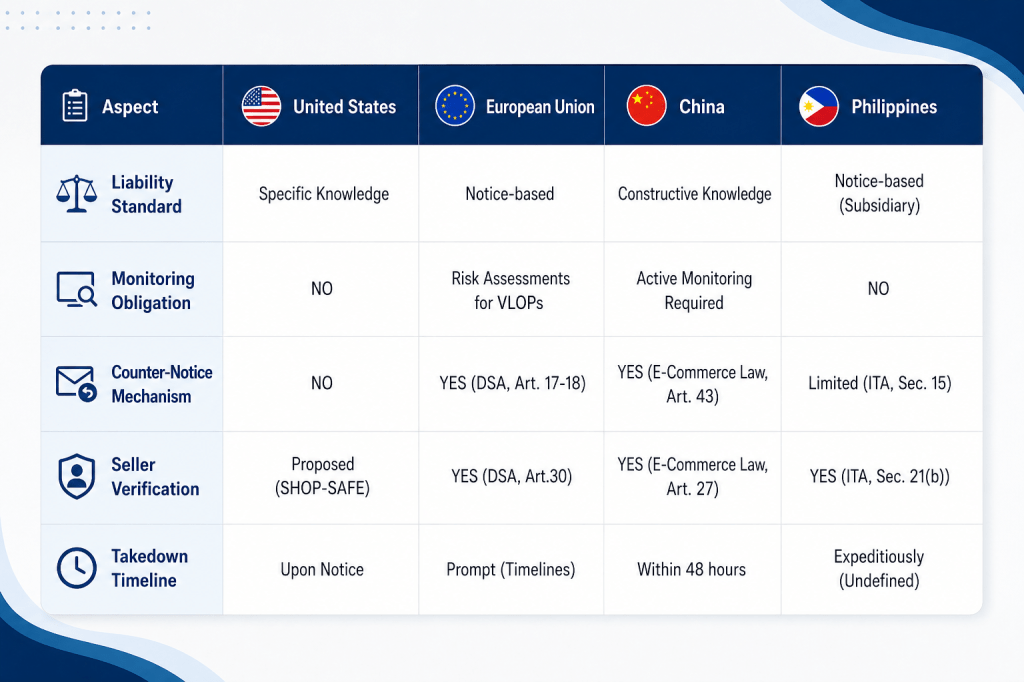
The United States provided a well-developed case law on secondary and contributory liability in the absence of platform-specific statutes. The Tiffany principle’s specific knowledge threshold protected platforms from liability for unknowingly hosting counterfeit products. The ITA’s notice-based trigger is consistent with this approach. However, the proposed SHOP SAFE Act suggests that even the US recognizes the need for stronger seller verification requirements that the Philippines already has under the ITA.
The European Union enacted comprehensive legislation mandating explicit proactive obligations upon platforms. The Digital Services Act’s (DSA) risk assessment requirements for very large online platforms (VLOPs) could be adapted to the Philippines. Additionally, the Louboutin “active participation” standard is directly relevant. Philippine platforms that warehouse, ship, or store counterfeit goods should lose intermediary protection; the ITA’s definition of e-marketplaces “that retain oversight over the consummation of the transaction” could be interpreted to incorporate this standard.
China adopted regulations requiring active monitoring and cooperation with rights holders. The “know or should have known” constructive knowledge standard, as applied in Louis Vuitton v. Wuxi Zhan Wang, is the most significant lesson. The Philippines should consider adopting this standard for high-risk product categories like pharmaceuticals, electronics, and cosmetics. The requirement that platforms take effective measures, not just merely forward complaints, is directly applicable. The price-based evidentiary rule also provides a workable standard.
Ultimately, the enactment of the ITA in 2023 has moved the Philippines closer to the EU model, wherein obligations are imposed upon e-commerce platforms, and liability attaches upon failure to act.
F. Legal Gaps and Challenges
Based on the foregoing, several legal gaps and challenges remain:
First, contributory infringement of trademark counterfeiting remains unavailable. While Section 76.6 of the IP Code provides for contributory infringement in patent law, and Section 22 of R.A. 10372 introduced contributory and secondary liability in copyright law, trademark law has no equivalent provision. This, in turn, forces brand owners to rely on direct infringement, subsidiary infringement, or administrative measures to seek recourse.
Second, no Supreme Court ruling has yet addressed platform liability for counterfeit goods. While there have been some cases regarding the legal status of platforms, until the courts rule directly on this issue, significant legal uncertainty persists.
Third, liability under ITA is only triggered upon failure to act after notice, and the law does not define what constitutes “expeditious” removal. This reactive standard does not capture platforms that deliberately design their systems to benefit from counterfeit while technically complying with takedown requests upon notice. Moreover, the ITA does not specify what “expeditiously” means in practice, leaving platforms with broad discretion and complainants with no assurance. This ambiguity creates a problem where counterfeit listings proliferate faster than rights holders can file notices, a concern recently noted by FDA Director General Paolo Teston (Pascual, 2026).
Fourth, no constructive knowledge standard. Under the ITA, platform liability only attaches upon failure to expeditiously act after due notice. This means that it does not capture instances wherein the platform should have known about obvious counterfeits.
Fifth, no seller-initiated counter-notice mechanism. While Section 15 of the ITA provides that “the violating entity shall be given an opportunity to be heard within forty-eight (48) hours from the issuance of a takedown order,” this measure only applies after the DTI has issued a takedown notice. Unlike China’s Article 43 counter-notice mechanism, the ITA does not allow an accused vendor to directly challenge a platform’s voluntary takedown and have a listing restored if the rights holder does not sue within a given period.
Sixth, no proactive monitoring for repeat offenders. The ITA imposes no obligation on platforms to track or act against repeat counterfeit sellers, allowing them to rise after being taken down.
Seventh, enforcement against foreign platforms without local presence remains challenging. While major e-commerce platforms like Shopee and Lazada have Philippine offices, certain smaller and foreign-based platforms may be difficult to reach through DTI enforcement.
Eighth, consumer-to-consumer (C2C) transactions fall outside ITA’s scope. The ITA primarily regulates business-to-consumer transactions, which means C2C sales through social media or messaging apps remain largely unregulated.
Ninth, consumer awareness of available remedies is low. As noted by Quijano & Natividad (2025), legal awareness is a significant factor in building e-commerce trust. However, most consumers still do not know how to file complaints with the DTI or pursue claims under the ITA.
Tenth, administrative remedies are limited. While the DTI can issue takedown orders and mandate fines, rights holders seeking monetary compensation must still pursue traditional routes like the IP Code remedies or attempt to hold the platforms accountable under the ITA.
V. CONCLUSION
Under existing Philippine law, e-commerce platforms may be civilly and administratively liable for counterfeit goods sold by third-party vendors. However, such liability can only attach under certain circumstances. First, under the Internet Transactions Act of 2023, liability attaches subsidiarily to the online marketplace when a digital platform fails to expeditiously act after receiving due notice of infringement. Direct liability is generally unavailable since platforms do not sell or manufacture the products themselves. Second, administrative remedies through the DTI provide faster relief than judicial alternatives. However, such administrative measures are limited to takedowns and fines, not damages or injunctive relief. While e-commerce platforms can be held liable for counterfeit products sold by third-party vendors, this accountability is reactive and narrow in scope.
As to the gaps of the current legal framework, several significant deficiencies emerge. Considering that the Consumer Protection Act (1992) and Intellectual Property Code (1997) were enacted prior to the rise of e-commerce platforms, these statutes do not address intermediary liability. Similarly, the Electronic Commerce Act (2000) does not define platform obligations for counterfeit products sold on such avenues. Critically, while Philippine copyright law has incorporated the concept of contributory infringement under R.A. 10372, trademark law has no equivalent provision. Due to this, brand owners are left without a clear cause of action for similar infringement. Additionally, the Internet Transaction Act’s reactive standard does not encompass scenarios wherein digital platforms should have known about obvious counterfeits.
Philippine jurisprudence regarding platform liability for counterfeit goods remains limited. However, the Supreme Court’s ruling in Borromeo and Mendaros offers guiding principles in discerning platform liability. The Court held that one must look beyond contractual labels and examine control over means and methods. Thus, e-commerce platforms that exercise the same level of control over third-party vendors may be held liable for counterfeit products hosted on their sites. Nonetheless, in the absence of the codification of such principles, legal uncertainty persists. To address this gap, the Intellectual Property Office of the Philippines (IPOPHL) facilitated an E-Commerce Memorandum of Understanding (MOU) between brand owners and online platforms, providing a practical notice-and-takedown mechanism. However, this measure is dependent on voluntary cooperation, and its effectiveness depends on the goodwill of the parties involved.
With respect to the foreign legal frameworks, comparative analysis reveals three distinct models practiced abroad. In the United States, the standard for platform liability to attach is specific knowledge of the infringement. Meanwhile, in the European Union, they follow a stricter approach by imposing proactive obligations and considering active logistical roles as potential triggers for direct liability, as exemplified in the Louboutin ruling. On the other hand, China follows an even more stringent approach grounded on a constructive knowledge standard. This means that digital platforms must take measures beyond merely forwarding notices. They have also adopted a counter-notice procedure with a 15-day grace period and a price-based evidentiary rule for liability to attach. Overall, these varying methods offer direct applicable lessons for Philippine reform.
VI. RECOMMENDATIONS
Based on the foregoing findings, the following are recommended:
First, amend the Intellectual Property Code to establish contributory liability for trademark counterfeiting. Legislators must pass provisions parallel to existing contributory liability in copyright and patent law for trademark. The amendment would provide stronger remedies for the holders of intellectual property rights over claims of infringement and administrative takedown procedures.
Second, obtain clearer guidance on platform liability. In the absence of a Supreme Court ruling on platform liability for counterfeit goods, the DTI should issue interpretative administrative guidelines to clarify platform obligations under existing laws. This includes clarifying what constitutes “expeditious” removal under the ITA.
Third, strengthen the ITA’s Notice-and-Takedown framework. Currently, liability arises only when a platform fails to act expeditiously on an infringement notice. However, this approach does not address the problem of repeat offenders. Policymakers should impose heavier obligations on platforms that deliberately design their system to tolerate counterfeiting and profit from it, while merely complying after receiving a takedown notice. Transparency and penalty escalation clauses should also be added to deter counterfeit sellers and repeat offenders.
Fourth, Philippine law must adopt a constructive knowledge standard for e-commerce platforms. Platforms should not avoid liability when obvious signs of counterfeit activity are already present, such as suspiciously low prices and repeated infringement complaints. Adopting a “know or should have known” principle recognized in China would encourage platforms to take earlier action against counterfeit goods. Such a standard would allow regulators and courts to hold platforms accountable even without formal notice when the circumstances clearly indicate counterfeit activity. However, this can still be a rebuttable presumption that can be overcome by the platforms’ evidence.
Fifth, adopt a seller-initiated counter-notice measure. Modeled after Article 43 of China’s E-Commerce Law, this measure would allow sellers to contest takedowns and complement the existing DTI-initiated due process clause under Section 15 of the ITA. Through this, a seller whose listing has been removed due to an intellectual property infringement complaint may submit a counter-notice contesting the claim. The platform must then forward the counter-notice to the complainant, who must initiate a corresponding response within a specified period. If no action is taken within the given time, the platform must restore the listing. Additionally, a nominal bond from the seller may also be implemented to deter bad-faith counter-notices.
Sixth, implement stricter measures against repeat counterfeit sellers. As the ITA does not require platforms to track repeated offenders, counterfeit sellers can easily create another account and repost counterfeit listings after takedown. Thus, platforms should adopt stricter verification systems for sellers, implement a three-strike policy, track repeated violators, and permanently suspend accounts that are involved in repeated counterfeit activities.
Seventh, improve enforcement against foreign e-commerce platforms. Foreign platforms operating in the Philippines must be required to establish local representatives or compliance offices to ensure the effective enforcement of DTI laws, administrative orders, and consumer remedies. The relevant government agencies should also be empowered to issue cease-and-desist orders against the foreign platforms’ payment gateways or domain names if they fail to comply with mandatory obligations.
Eighth, expand ITA’s scope to encompass platform-facilitated consumer-to-consumer (C2C) transactions. The ITA should cover consumer-to-consumer transactions in instances where platforms involve themselves in payment processing, logistics, or commission. Considering that the platforms benefit from the C2C transactions, they must comply with notice and takedown measures to promote a safe online space. However, pure consumer-to-consumer transactions remain excluded.
Ninth, enhance consumer awareness of available remedies. Government agencies should launch public information campaigns about consumer rights under the ITA and the process for filing complaints to improve consumer protection and trust in online marketplaces. Platforms should also be required to prominently display DTI-complaint links or an infographic detailing consumer rights and the process for filing complaints on their sites.
Tenth, expand the administrative remedies under the ITA and related laws. The DTI’s power should be expanded to award reasonable monetary compensation in clearly established cases of online counterfeiting, particularly for undisputed or repeat violations. A small-claims mechanism should likewise be established within the DTI for claims below a certain threshold.
VII. BIBLIOGRAPHY
A. Statutes and Legislative Materials
Philippines
Commonwealth Act No. 46, An Act to Prohibit False or Fraudulent Advertising, Mislabeling, or Misbranding of Products (1936). Available at: https://lawphil.net/statutes/comacts/ca1936/ca_46_1936.html
Online Scammer Accountability Act, House Bill No. 9530, 19th Congress, 1st Session (2023). Available at: https://ldr.senate.gov.ph/bills/house-bill-no-9530-19th-congress
Online Transaction Buyer Protection Act of 2023, House Bill No. 9531, 19th Congress, 1st Session (2023). Available at: https://issuances-library.senate.gov.ph/bills/house-bill-no-9531-19th-congress
Republic Act No. 172, An Act to Amend the Revised Penal Code (1947). Available at: https://lawphil.net/statutes/repacts/ra1947/ra_172_1947.html
Republic Act No. 7394, Consumer Act of the Philippines (1992). Available at: https://www.officialgazette.gov.ph/1992/04/13/republic-act-no-7394-s-1992/
Republic Act No. 8293, Intellectual Property Code of the Philippines (1997). Available at: https://www.officialgazette.gov.ph/1997/06/06/republic-act-no-8293/
Republic Act No. 10372, An Act Amending Certain Provisions of Republic Act No. 8293, Otherwise Known as the “Intellectual Property Code of the Philippines” (2013). Available at: https://elibrary.judiciary.gov.ph/thebookshelf/showdocs/2/53393
Republic Act No. 11967, Internet Transactions Act of 2023 (2023). Available at: https://lawphil.net/statutes/repacts/ra2023/ra_11967_2023.html
United States
SHOP SAFE Act (Stopping Harmful Offers on Platforms by Screening Against Fakes in E-Commerce Act), S 1372, 118th Congress (2023). Available at: https://www.congress.gov/bill/118th-congress/senate-bill/2934/text
China
E-Commerce Law of the People’s Republic of China (2018). Available at: https://www.chinalawtranslate.com/en/p-r-c-e-commerce-law-2018/
Trademark Law of the People’s Republic of China (1993). Available at: https://www.wipo.int/wipolex/en/legislation/details/845
European Union
Digital Services Act, Regulation (EU) 2022/2065 of the European Parliament and of the Council of 19 October 2022 on a Single Market for Digital Services and amending Directive 2000/31/EC. Available at: https://eur-lex.europa.eu/eli/reg/2022/2065/oj/eng
B. Philippine Jurisprudence
Borromeo v. Lazada E-Services Philippines, Inc., GR No. 265610 (Supreme Court of the Philippines, 3 April 2024). Available at: https://lawphil.net/judjuris/juri2024/apr2024/gr_265610_2024.html
Mendaros v. Lazada E-Services Phil., Inc., GR No. 257821 (Supreme Court of the Philippines, 19 August 2024). Available at: https://lawphil.net/judjuris/juri2024/aug2024/gr_257821_2024.html
C. Foreign Jurisprudence
United States
Tiffany (NJ) Inc. v. eBay Inc., 600 F. 3d 93 (2d Cir, 2010). Available at: https://law.justia.com/cases/federal/appellate-courts/ca2/08-3947/08-3947-cv_opn-2011-03-27.html
European Union
Coty Germany GmbH v. Amazon Services Europe Sàrl, Case C-567/18, ECLI:EU:C:2020:267 (Court of Justice of the European Union, Fifth Chamber, 2 April 2020). Available at: https://eur-lex.europa.eu/legal-content/EN/TXT/?uri=celex:62018CJ0567
Louboutin v. Amazon, Joined Cases C-148/21 and C-184/21 (Court of Justice of the European Union, 22 December 2022). Available at: https://www.casalonga.com/jurisprudence/court-of-justice-of-the-european-union-xxx-v-xxx-3246.html?lang=en
China
Louis Vuitton Malletier v. Wuxi Zhan Wang Co., Ltd., (2016) Su 0291 Min Chu No. 909 (Wuxi New District People’s Court), aff’d (2016) Su 02 Min Zhong No. 4381 (Wuxi Intermediate People’s Court) (China). Available at: https://iprchn.com/cipnews/news_content.aspx?newsId=111624
D. Books, Articles, and Commentaries
Andrade, J, ‘House Bill No. 9530: Online Scammer Accountability Act and House Bill No. 9531: Online Transaction Buyer Protection Act of 2023’ (19th Congress, House of Representatives, 2023). Available at: https://plus.inquirer.net/news/2-bills-to-protect-online-shoppers-vs-scammers/
Axalan-Posio, M, ‘The Liability of Online Marketplaces for Sale of Counterfeit Goods’ (DivinaLaw, 18 May 2020). Available at: https://www.divinalaw.com/news-and-updates/liability-online-marketplaces-sale-counterfeit-goods/
Balaoing, B, ‘PH E-Commerce Market Outperforming Others in SE Asia’ (ABS-CBN News, 5 November 2025). Available at: https://www.abs-cbn.com/news/business/2025/11/5/ph-e-commerce-market-outperforming-others-in-se-asia-lazada-1938
Delantar, NJP, ‘Protecting Brands in Cyberspace and E-Commerce Transactions’ (ACCRAL, 7 January 2026). Available at: https://accralaw.com/2026/01/07/protecting-brands-in-cyberspace-and-e-commerce-transactions/
Estremadura, JJM, ‘Trademark Infringement in the World of Online Shopping’ (BusinessWorld, 17 November 2020). Available at: https://www.bworldonline.com/editors-picks/2020/11/17/329235/trademark-infringement-in-the-world-of-online-shopping/
Howe, S, ‘Social Media Statistics in the Philippines [Updated 2026]’ (Meltwater, 30 March 2026). Available at: https://www.meltwater.com/en/blog/social-media-statistics-philippines
Leiser, MR, van Leeuwen, D., and Anemaet, L, ‘Online Intermediaries and Trademark Owners: The Legal Position and Obligations of Online Intermediaries to Trademark Owners Prior and Post-Louboutin v Amazon’ (2024) JIPITEC – Journal of Intellectual Property, Information Technology and E-Commerce Law. Available at: https://papers.ssrn.com/sol3/papers.cfm?abstract_id=4690624
Maliwat, R, ‘US Chamber Lauds IPOPHL’s Anti-Counterfeiting Cooperation and Stronger IP Protection Measures in 2026 Int’l IP Index’ (IPOPHL, 6 April 2026). Available at: https://www.ipophil.gov.ph/news/us-chamber-lauds-ipophls-anti-counterfeiting-cooperation-and-stronger-ip-protection-measures-in-2026-intl-ip-index/
Panaga, AT and Sanger, SJ, ‘E-Commerce and IP Laws: Re-Shaping Current E-Commerce Laws and Policies in the Philippine Setting to Accommodate the Protection of Intellectual Property Rights’ (JD Thesis, De La Salle University, 2020). Available at: https://animorepository.dlsu.edu.ph/etdm_law/18/
Pascual, J, ‘FDA Warns of Fake Products Sold Online’ (ABS-CBN News, 3 March 2026). Available at: https://www.abs-cbn.com/news/business/2026/3/3/fda-warns-of-fake-products-sold-online-1743
Quijano and Natividad, ‘Understanding the Role of Legal Awareness in Building E-Commerce Trust Among Gen Z Consumers’ (ResearchGate, 2025). Available at: https://www.researchgate.net/publication/395555641_Understanding_the_Role_of_Legal_Awareness_in_Building_E-Commerce_Trust_Among_Gen_Z_Consumers
Waite, P, ‘Intermediary Liability: Rules, Risks and Reforms in the Digital Age’ (Wray Castle, 10 February 2026). Available at: https://wraycastle.com/blogs/telecoms-regulation-knowledge-base/intermediary-liability-rules-risks-and-reforms-in-the-digital-age
Wu, H. and Li, F., ‘Rules for Determining Civil Liability of Online Platforms for IP Infringement in China’ (CCPIT Patent and Trademark Law Office, 13 May 2026). Available at: https://www.ccpit-patent.com.cn/news/Intellectual/other/2026/0513/5501.html


